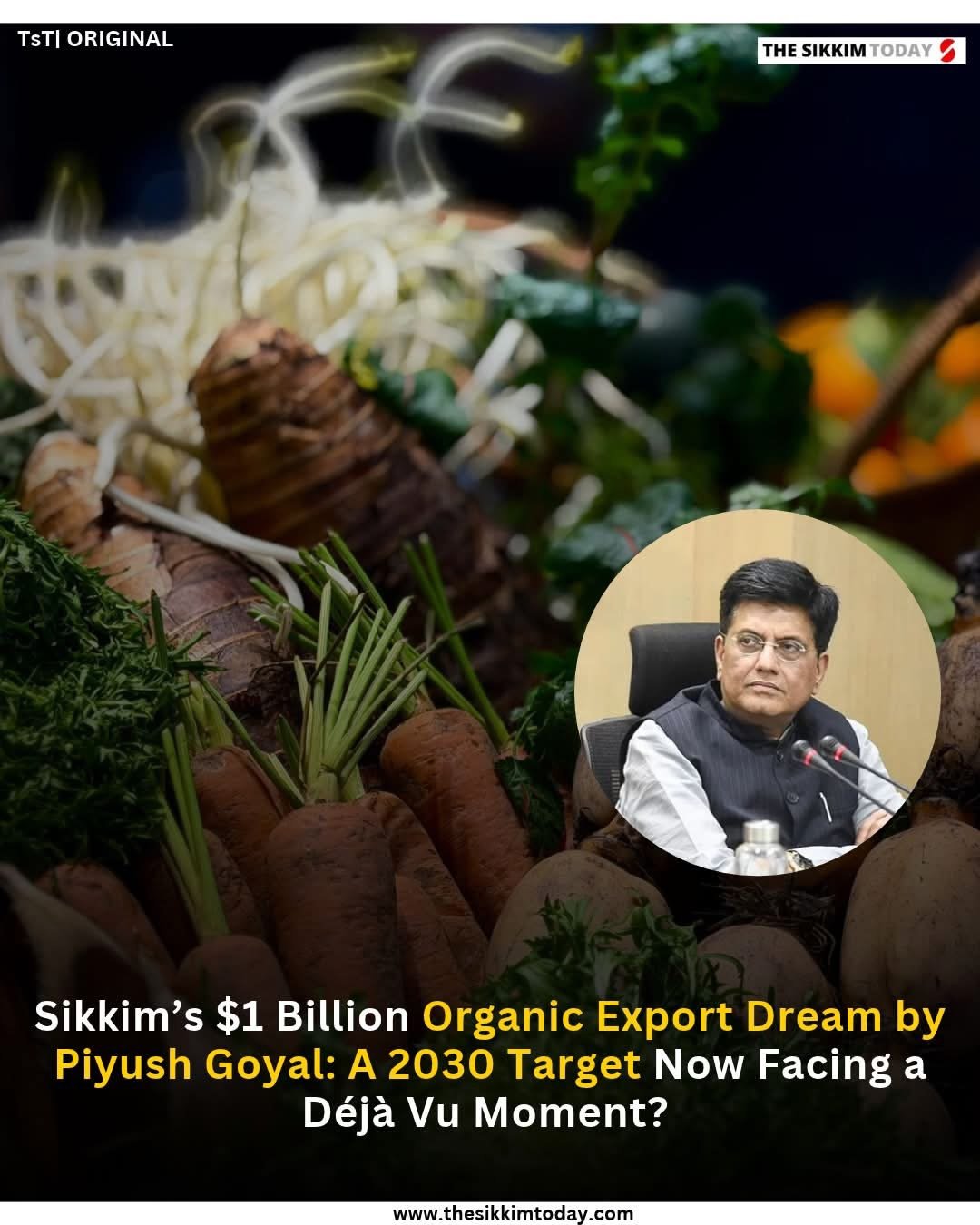
In February 2023, Union Commerce Minister Piyush Goyal envisioned a remarkable transformation for Sikkim, urging the state to increase organic exports from approximately US$1 million to US$1 billion by 2030. More than three years later, the ambitious dream raises a difficult question: Is Sikkim building an export economy, or merely showcasing products at exhibitions?
According to the NITI Aayog Export Preparedness Index 2024, Sikkim recorded total exports worth approximately ₹144 crore in FY 2023–24, ranked 31st with an export preparedness score of 33.75. Pharmaceuticals dominate the state’s export basket, while organic agriculture, spices, tea, handicrafts and processed foods remain sectors with considerable untapped potential.
The challenges are structural. An APEDA-backed export-readiness study identifies only 19 processing centres and two cold-storage facilities in Sikkim, located at Melli and Rangpo. The report estimates that nearly 25% of agricultural produce is lost due to inadequate storage, transportation and post-harvest handling. It also highlights gaps in testing laboratories, aggregation, grading, processing capacity and packaging—critical requirements for international trade.
In 2026, Rajya Sabha MP D.T. Lepcha also raised concerns over the need to strengthen packaging and market-readiness of Sikkim’s products, keeping the issue of improving the state’s commercial competitiveness alive.
Meanwhile, government initiatives under Sikkim INSPIRES and the Commerce and Industries Department have showcased local products in metropolitan markets, including Bengaluru, where 94 entrepreneurs participated in Sikkim Utsav 2026. Such exposure creates visibility, but the larger question remains: can local enterprises consistently meet demand, maintain quality, ensure competitive pricing and supply products across India?
A positive development, however, is the international expansion of Sikkim Supreme, the state’s iconic food-processing brand. Its first export consignment to the United States and Australia in November 2026 includes pickles, squashes, jams and other products. The initiative marks a significant milestone for the Government Fruit Preservation Factory, established in 1956, and offers potential benefits to local farmers supplying raw materials.
But will this international expansion continue beyond the first consignment?
Sikkim has ginger, turmeric, large cardamom, Dalle chilli, tea and organic produce capable of building niche markets. What remains missing is the scale, supply-chain reliability, processing infrastructure, certification, skilled manpower and sustained buyer relationships necessary to transform potential into exports.
The $1 billion dream may not be impossible—but without measurable progress, transparent targets and consistent execution, Sikkim risks another déjà vu moment: a promising vision repeatedly announced, showcased and celebrated, but yet to reach its full economic potential.