Monday, August 24, 2026
Home Blog Page 13

Spear Corps Demonstrate Tactical Excellence in Exercise Dibang Shakti

0

In a remarkable display of operational prowess, the elite troops of the Indian Army’s SpearCorps successfully conducted a high-intensity exercise titled ‘Dibang Shakti’ deep in the challenging terrain of Dibang Valley. The exercise was meticulously designed to test and validate the troops’ asymmetric warfare capabilities under extremely demanding conditions of dense jungles, steep mountains, and unpredictable weather.

During the exercise, the troops showcased exceptional skill in a variety of tactical domains, including specialized survival techniques, jungle warfare, and combat free falls operations. The operation demanded not only physical endurance and sharp tactical acumen but also a high degree of mental resilience, as soldiers navigated through rugged, uncharted terrain under simulated combat scenarios.

‘Dibang Shakti’ was aimed at reinforcing the preparedness of the troops to counter unconventional threats and conduct rapid-response operations in high-altitude and jungle environments, which are critical in the context of India’s eastern borders. The seamless coordination between various arms of the armed forces, along with advanced technology applications, demonstrated the Indian Army’s focus on holistic combat readiness.

This exercise further strengthened the patriotic zeal and commitment of the troops towards securing the nation’s sovereignty. It exemplified the Indian Army’s motto of being ever-prepared, with a strong emphasis on innovation, tactical brilliance and unyielding resilience.

The successful completion of Exercise Dibang Shakti reflects the continued focus of the Indian Army in enhancing operational capability, readiness and adaptability to face future challenges. The endeavour inspires confidence among citizens and reaffirms the steadfast commitment of the Indian Army towards securing the nation’s frontiers.

The Rise of Sustainable Play Spaces: Eco-Friendly FRP-Based Equipment is Transforming Community Parks and Schools

0

Fiber Reinforced Plastic (FRP)-based play equipment is becoming more and more popular in parks and schools as a long-lasting, environmentally responsible substitute for wood and metal. FRP guarantees long-term use while demonstrating a dedication to sustainability because it is resistant to rust, deterioration, and weather damage. It is robust, lightweight, and ideal for contemporary public areas.

FRP equipment encourages inclusivity and safety in addition to durability. Recyclable materials lessen their influence on the environment, while smooth, non-toxic surfaces diminish the chance of accidents. FRP is being used by educational institutions, housing complexes, and public planners to create play areas that promote social contact, physical activity, and environmental awareness among kids and families.

According to industry analysts, FRP will influence how urban play infrastructure develops in the future. Its eco-friendly appeal, adaptable designs, and low maintenance requirements help achieve sustainable development objectives and Smart City projects. It can also be customized according to one’s imagination and requirement, offering flexibility for unique concepts. Strongly recommended for resorts and coastal schools, FRP withstands salty environments, making it a superior substitute to traditional alternatives. More than innovation, it symbolizes a change to more environmentally friendly living, where kids grow up in environments that are safe and sustainable.

Sujit Dutta of Wonderland Mangala Industries said, “Bengal has always been a creative hub, nurturing both talent and craftsmanship, and giving the world icons like Rabindranath Tagore, Satyajit Ray, Amartya Sen, Mrinal Sen, Pritam Chakraborty, Sabyasachi, Shantanu Moitra, Kumar Sanu, and Arijit Singh. Building on this legacy, we want to take Bengal’s creativity to the international stage through innovations in play zones, water parks, and resort experiences. FRP is a product that makes it possible to turn imagination into reality, adding unique value to resorts and leisure destinations, while also creating significant employment opportunities.”

Middle-Aged Woman Found Dead in Rented Flat in Gangtok

0

The semi-decomposed body of a middle-aged woman, later identified as Hema Devi Chettri, a resident of Lingdok, was found today in a rented flat located in the Green Dale area, Tadong, Gangtok.

The discovery was made after local residents alerted police about a foul smell coming from the flat situated above Greendale School in Gairigaon, Tadong. Upon arrival, the police recovered the body and found a man identified as Zayed Ansari, a carpenter from Namchi, present at the scene in an intoxicated state.

Authorities suspect Zayed Ansari’s involvement, as he had reportedly been staying with the deceased for the past three days. The exact nature of their relationship, including whether they were live-in partners, is part of the ongoing investigation.

The Sadar Police Station, Gangtok, has taken the accused into custody. The body has been transferred to STNM Hospital for a post-mortem examination.

Police sources revealed that multiple angles, including homicide, are being thoroughly investigated. A press conference by Sikkim Police officials is expected soon to provide further updates.

India’s Defiant Stand: How Economic Resilience Thwarted Trump’s Tariff Threats

0

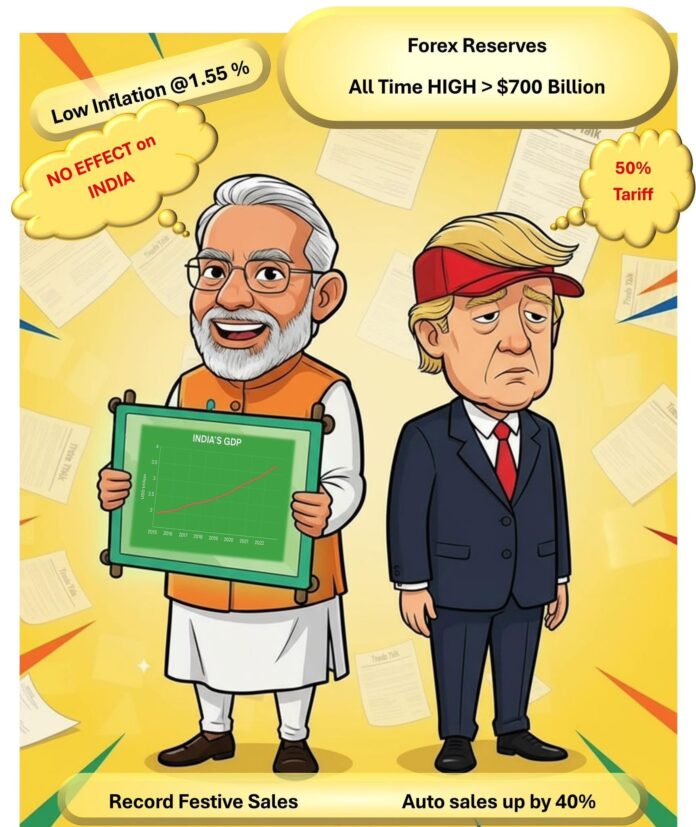
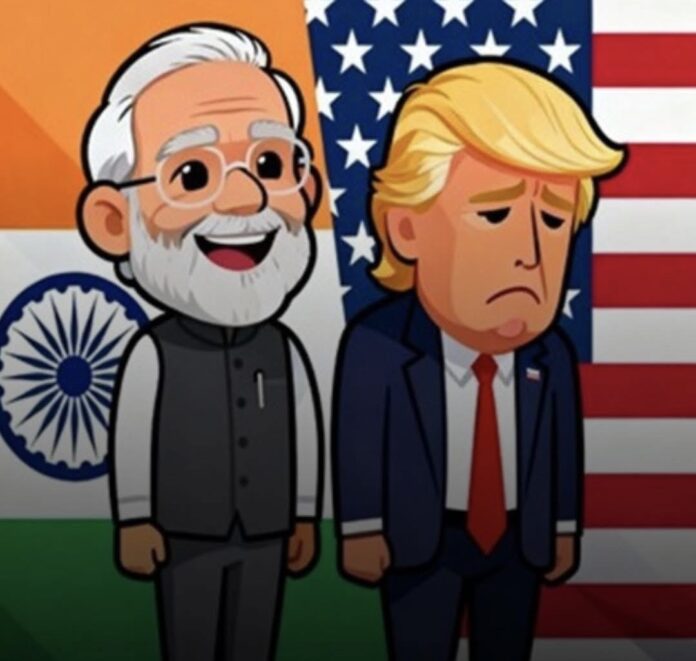
The Trump administration’s decision to impose punitive 50% tariffs on India, citing its purchase of Russian oil, was widely seen as a strategic move to pressure New Delhi. However, this aggressive policy exposed glaring double standards, as several Western countries continued similar trade practices without facing penalties.

Rather than bending to the pressure, India responded with steadfast determination. Its economy continued to surge, registering an impressive 7.8% GDP growth — the highest in five quarters. The manufacturing sector played a pivotal role, expanding by 7.7% and demonstrating the country’s economic resilience.

This situation revealed a fundamental miscalculation by the Trump administration. India’s large domestic market and diversified economy proved far more resilient than Washington anticipated, debunking the narrative of dependence on external markets.

Ultimately, India’s response was not just economic but strategic. By standing firm, India reinforced its commitment to economic sovereignty and strategic autonomy, turning the tariff gambit into a demonstration of strength rather than weakness.

Indian Army Delivers 300 Kg Food, Water, and Essentials to Stranded Chilla Village

0

The troops of Gurj Division, in coordination with the Civil Administration, launched a drone operation to deliver food, water, medicines and essential supplies to the people of remote Chilla village in Kathua District of Jammu region.

The village, located on the banks of the Ujh River, has been cut off from all sides due to extensive damage to roads and bridges caused by the recent floods. With conventional access blocked, the Civil Administration sought assistance from the Indian Army.

Troops of Gurj Division responded swiftly, mobilised with load carrying drones and essential supplies, moving over challenging terrain and through rough weather reaching Plal village on Western side of Ujh River by 5 PM on 7 Sep 25. The drone operations across the river commenced immediately and continued till late night delivering 150 kgs of essential ration. The relief operations resumed on 8th Sep morning and delivered another 150 kg making it a total of 300 kgs. The 16 stranded families cut off for last 20 days expressed joy and gratitude on receiving the ration and thanked Indian Army and Kathua District Administration for their proactive action.

Troops of the Rising Star Corps have been undertaking massive rescue and relief operations across the region since 17 August 2025. While flood relief columns remain deployed to respond to emerging situations, Army personnel are reaching out to isolated villages, providing food, water, medicines, organising medical camps and working to restore road connectivity.

The Indian Army reaffirms its commitment to stand by the people in times of crisis, bringing timely relief and hope to those affected.

Wall of Kindness Inaugurated at Chhangu: From Walls of Defence to Walls of Compassion

0

Amidst the tranquil yet formidable heights of Chhangu, where every stone whispers tales of vigilance and sacrifice, a radiant symbol of humanity was unveiled, the Wall of Kindness. Inaugurated by the Black Cat Division of the Indian Army, this initiative stands as a living testament to compassion, dignity and the indomitable spirit of Service Before Self.

The solemn event began with an introductory address highlighting the noble vision behind the construction of the Wall of Kindness, followed by the traditional lighting of the lamp, a symbol of wisdom and hope in the harsh Himalayan heights. The moment of unveiling, when the curtains were drawn back to reveal the wall, resonated deeply, carrying with it the promise of compassion etched into stone.

Known locally as “Neki ki Deewar”, this wall bears a simple yet profound message, “one may leave what they can, and others may take what they need.” In these few words lies a bridge between the might of the Indian Army and the heart of the people it protects.

In a region where icy winds test endurance and life is carved against the odds, the Wall of Kindness brings warmth, not just of donated essentials, but of shared humanity. As soldiers guard the nation’s frontiers with unyielding resolve, they now also guard and nurture the values of dignity and compassion, ensuring that no neighbour is left behind.

The initiative by the Indian Army transforms the very meaning of walls, from barriers of defence to beacons of compassion. What once symbolised fortification now shines as a monument of giving, reminding all that the strength of a nation is not measured only by the power of its arms, but also by the depth of its humanity.

It is a wall that does not divide but unites, a wall that does not shield but shares, a wall that reflects strength tempered with kindness.

At Chhangu, under the watchful gaze of the Himalayas, this Wall of Kindness has become more than stone and paint, it has become a pledge. A pledge of shared compassion by all of us, who visit Chhangu or Natu La. The Tiranga may flutter at the heights as a symbol of sovereignty, but alongside it now stands a wall that embodies the heartbeat of 1.4 billion Indians, compassion first, humanity always.

“From building Walls of Defence to Walls of Compassion, the Indian Army shows that true strength lies not only in holding ground, but in holding hearts.”

Sikkim Renews Talks With Centre to Facilitate 17th Karmapa’s Return to Rumtek

0

The Sikkim government has renewed its efforts to bring back the 17th Karmapa, Ogyen Trinley Dorje, to Rumtek Monastery, an issue that has remained unresolved for decades.


Ecclesiastical Affairs Minister Sonam Lama confirmed that the state is working with the Union government to re-establish contact with the Karmapa. Once communication is secured, a formal invitation will be extended on behalf of the state.

Lama recently met Union Home Minister Amit Shah, Defence Minister Rajnath Singh, and Union Minister Kiren Rijiju in New Delhi. He stated that Shah expressed willingness to personally communicate with the Karmapa if official channels succeed.

A dedicated committee has been formed under Lama’s leadership, with around ₹1 crore allocated in the state budget to support the initiative, continuing a trend of annual allocations.

For Sikkim’s Buddhist community, the Karmapa’s return holds immense religious significance. Rumtek, rebuilt in the 1960s by the 16th Karmapa, has stood without its spiritual head for over four decades due to succession disputes.

Recognised by the Dalai Lama, Ogyen Trinley Dorje fled Tibet in 1999, lived under Indian protection, and later acquired Dominican citizenship. His return since leaving India in 2017 has been hindered by citizenship and visa complications.

India’s Ethanol Manufacturing: Nitin Gadkari and His Son Trolled Without Knowing Facts

0

A recent social media campaign has alleged a conflict of interest involving Union Minister Nitin Gadkari and his sons over ethanol production in India. The claims suggest that Gadkari promotes ethanol blending in petrol to benefit his family’s businesses. However, a closer look at the facts tells a different story.

Nitin Gadkari’s family companies — CIAN Agro (established in 1995) and Manas Agro (established in 2012) — indeed produce ethanol, but their share in India’s total production is minimal, estimated at just 0.6 percent. In contrast, leading ethanol suppliers include Balrampur Chini Mills, Triveni Engineering, Dhampur Sugar Mills, and Dwarikesh Sugar Industries, each contributing between 5–10 percent.

India’s ethanol blending programme did not begin under Gadkari’s watch. It was launched in 2003 under the Vajpayee government with 5 percent blending. The UPA government later attempted to expand it but managed little progress. The scaling up to E10 and the ongoing push towards E20 by 2025 has been spearheaded by the current government, where Gadkari has served as a prominent face but not the architect of the policy.

Critics have highlighted revenue growth in Gadkari’s sons’ companies, which rose from ₹17 crore to ₹510 crore in a year. Yet experts point out that even this figure accounts for less than one percent of national ethanol supply. After expenses and taxes, actual profit margins are likely far lower.

With production capacity surging from 421 crore litres in 2013–14 to 1,810 crore litres in 2023–24, boosting petrol blending from 1.53% to nearly 19%. This expansion has saved over ₹1.1 lakh crore in foreign exchange while supporting farmers.

To meet the E20 blending target by 2025, the government recently allowed ethanol production from sugarcane juice, syrup, and molasses without volume limits, while also incentivizing use of grains and dairy byproducts. Amul, for example, has converted whey into 20,000 litres of ethanol and plans a ₹70 crore plant capable of producing 50,000 litres daily.

Major players include Bajaj Hindusthan, Shree Renuka Sugars, and Godavari Biorefineries, alongside second- and third-generation refineries in Panipat, Bhatinda, and Bargarh. Yet, logistical hurdles remain, with only 18,000 fuel stations offering E20 blends.

Allegations around Union Minister Nitin Gadkari’s family businesses have drawn attention, but their combined ethanol output—about 84 million litres—accounts for just 0.6% of national capacity. Industry analysts note that the real gains lie in diversified producers and farmers benefiting from higher procurement prices and stable demand.

Globally, ethanol blending is standard practice: Brazil uses E27, the US widely supplies E10, E15, and E85, and Europe and China rely on E10. In India, the Supreme Court recently dismissed petitions against ethanol-blended petrol, underlining its acceptance.

Observers note that if there are concerns about monopoly or profit, scrutiny should focus on the major ethanol producers rather than Gadkari’s family, whose market share remains negligible.

Analysts suggest that while opposition parties have targeted Gadkari over alleged conflict of interest, the allegations lack merit. Critics argue that if the minister must be held accountable, it should be on governance issues such as road quality and toll collection — not on a policy where his family’s role is statistically insignificant.

Northeast India Leads Nation in Cancer Rates, NCRP Study Reveals

0

A comprehensive study under the National Cancer Registry Programme (NCRP) has uncovered striking regional disparities in cancer incidence across India. Among the 43 population-based cancer registries (PBCRs) surveyed between 2015 and 2019, Aizawl, East Khasi Hills, Papumpare, and Kamrup Urban emerged as the areas with the highest cancer incidence rates nationwide.

During this five-year period, a staggering 708,000 new cancer cases were recorded, accompanied by 206,000 deaths. Women accounted for 51.1 percent of these cases, while men bore a disproportionately higher share of mortality—55 percent of the deaths.

The Aizawl district in Mizoram stood out distinctly with the country’s highest age-adjusted incidence rates (AAIR) for both sexes—256.1 per 100,000 men and 217.2 per 100,000 women. Data also positioned East Khasi Hills in Meghalaya with elevated rates, and Papumpare in Arunachal Pradesh similarly ranking high.

Site-specific trends revealed areas of concern: East Khasi Hills reported the highest incidence of esophageal cancer, while Aizawl led in stomach, lung, and gallbladder cancers. Papumpare showed the highest age-adjusted rates for stomach, liver, and cervical cancers.

Experts highlight that lifestyle patterns, tobacco consumption, dietary habits, and late diagnosis contribute significantly to these high numbers. Limited healthcare infrastructure in several Northeastern states further adds to the challenge, delaying early detection and effective treatment.

The findings underscore the urgent need for robust cancer control strategies in Northeast India. Health authorities are being urged to focus on screening programs, early diagnosis, and community-based awareness initiatives tailored to the region’s unique risk factors.

Nepali Language Made Mandatory in Telecom Communications in Sikkim

0

The Government of India’s Department of Telecommunications (DoT) has directed all telecom service providers operating in the state to include Nepali language in their customer-related communications.

As per the Office Memorandum issued by the Licensing Policy Division of the DoT on September 2, all licensees must now incorporate Nepali across telecom-related services. This includes IVRS messages, SMS, call centre support, and other customer communication systems.
The order mandates telecom operators to take the necessary steps to implement the directive within 30 days and submit compliance reports to the concerned License Service Area (LSA) office.

Officials stated that the move will enhance accessibility and convenience for users, ensuring that subscribers in Sikkim receive essential information in their widely spoken and officially recognized language.

The memorandum, approved by the competent authority, has been circulated to all Unified License (UL/VNO) holders as well as Internet Service Providers (ISPs) in the state.