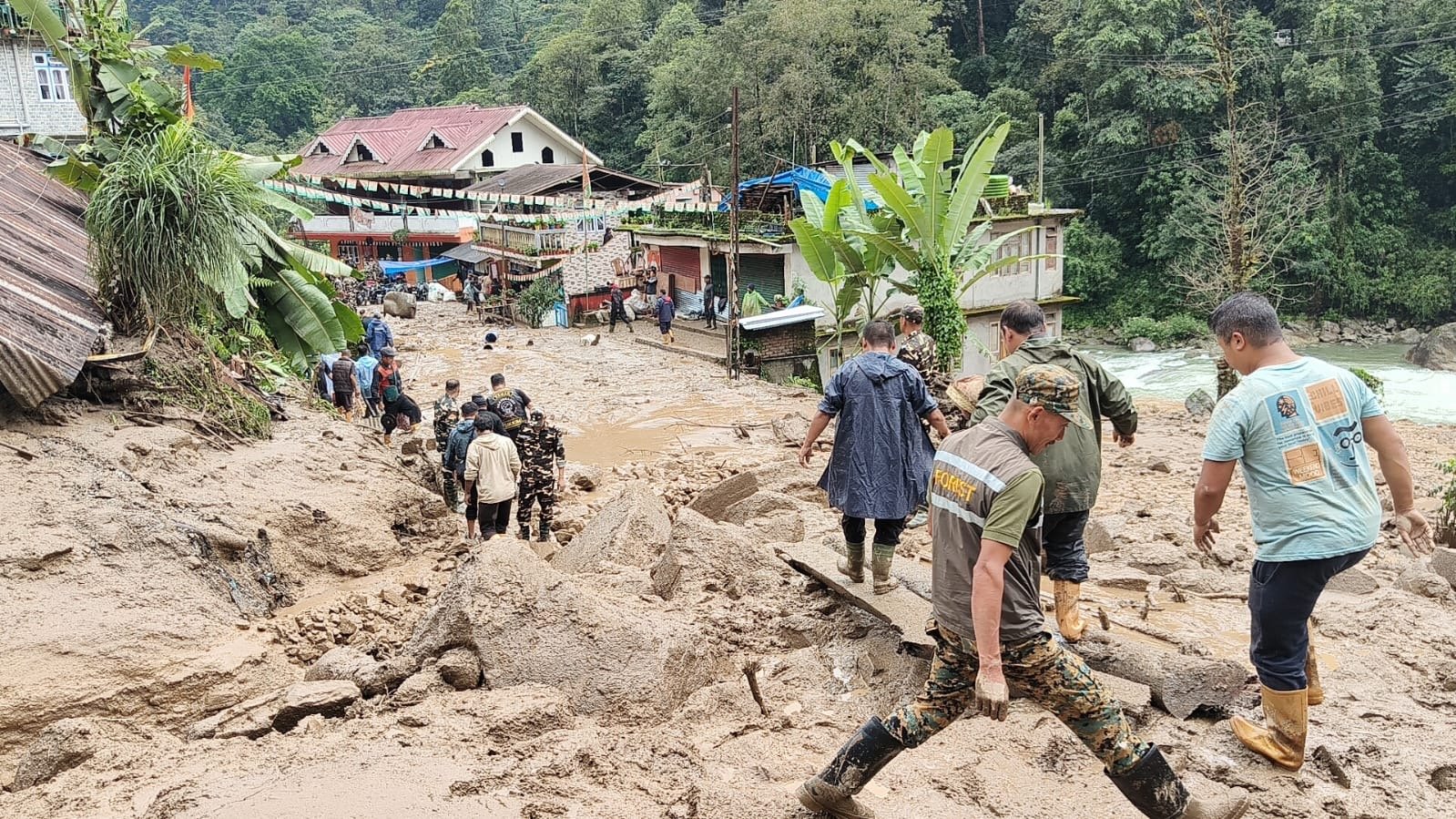
The continuing landslide at Rimbi in Gyalshing district has brought renewed attention to the fragile mountain slopes of the region, where prolonged rainfall, unstable geological formations and changing water flow appear to be interacting to destabilise the hillside.
The present Rimbi–Singlitam slope movement became increasingly active from August 2026 and has since expanded, affecting homes and forcing residents from vulnerable areas. Authorities have been monitoring the situation as fresh movement and debris continue to pose risks to the settlement below.
The problem, however, cannot simply be described as a soil failure. The wider Rimbi–Yuksom area has slopes comprising soil over fractured and jointed rock formations. Such terrain can become particularly vulnerable when prolonged rainfall allows water to penetrate the soil and cracks within the underlying rock.
As the ground becomes saturated, water pressure can increase within the slope, reducing its stability. Once movement begins, large quantities of soil, weathered rock and boulders can travel downslope, creating a secondary threat in the lower areas.
Water flow is another critical part of the Rimbi situation. Landslide debris has accumulated around the NiK Kholsa stream, affecting natural drainage. The Rimbi River has also altered its course in places and is reportedly eroding the roadside slope. Such changes can concentrate water against already weakened ground, potentially accelerating erosion and further slope movement.
This creates a dangerous cycle: rainfall weakens the upper slope, slope failure sends debris downward, debris alters drainage, and concentrated water can then erode the lower slope.
The geological history of the area provides important context. An official Sikkim landslide inventory identifies the Melli Slide between Yuksom and Rimbi as a complex, active landslide involving a quartzite-phyllite formation interbedded with soil. Its recorded average depth is about 20 metres, reaching a maximum of 35 metres, with an estimated failed volume of around 225,000 cubic metres. The inventory identifies highly jointed, weak geological formations as a major trigger. Importantly, these measurements relate to the Melli slide and should not be presented as measurements of the present Rimbi failure.
A 2020 field study of slope failures around Yuksom similarly found widespread phyllite, schist and quartzite, with rocks described as fractured, weathered and containing multiple discontinuities. Researchers identified geological structure and rainfall among the principal factors associated with the failures.
Research published in 2022, using 688 landslide inventory locations across Sikkim, further identified rainfall, slope angle, geology, soil, drainage, distance from rivers and groundwater-related terrain factors among the parameters used to assess landslide susceptibility. The warning signs continued into 2025. In September that year, a major landslide in Upper Rimbi/Yangthang, triggered during heavy rain, killed four people and left three others unaccounted for.
The history of landslides in the wider Rimbi area also shows that slope instability is not entirely new. A major landslide in Upper Rimbi/Yangthang in September 2025 caused fatalities, while earlier incidents have affected roads and infrastructure.
The immediate question, therefore, is not simply whether Rimbi has a “soil problem” or a “rock problem”. It is how rock structure, soil, rainfall, groundwater and river erosion are interacting across the entire slope system.
Whether particular portions of Rimbi should be considered permanently unsafe requires detailed geological and geotechnical assessment. Field mapping, subsurface investigations, drainage studies and continuous monitoring would be necessary before drawing such a conclusion.
For residents living below the active slope, however, the message is already clear: until the ground stabilises and scientific assessments establish safe zones, continued vigilance and precaution remain essential.