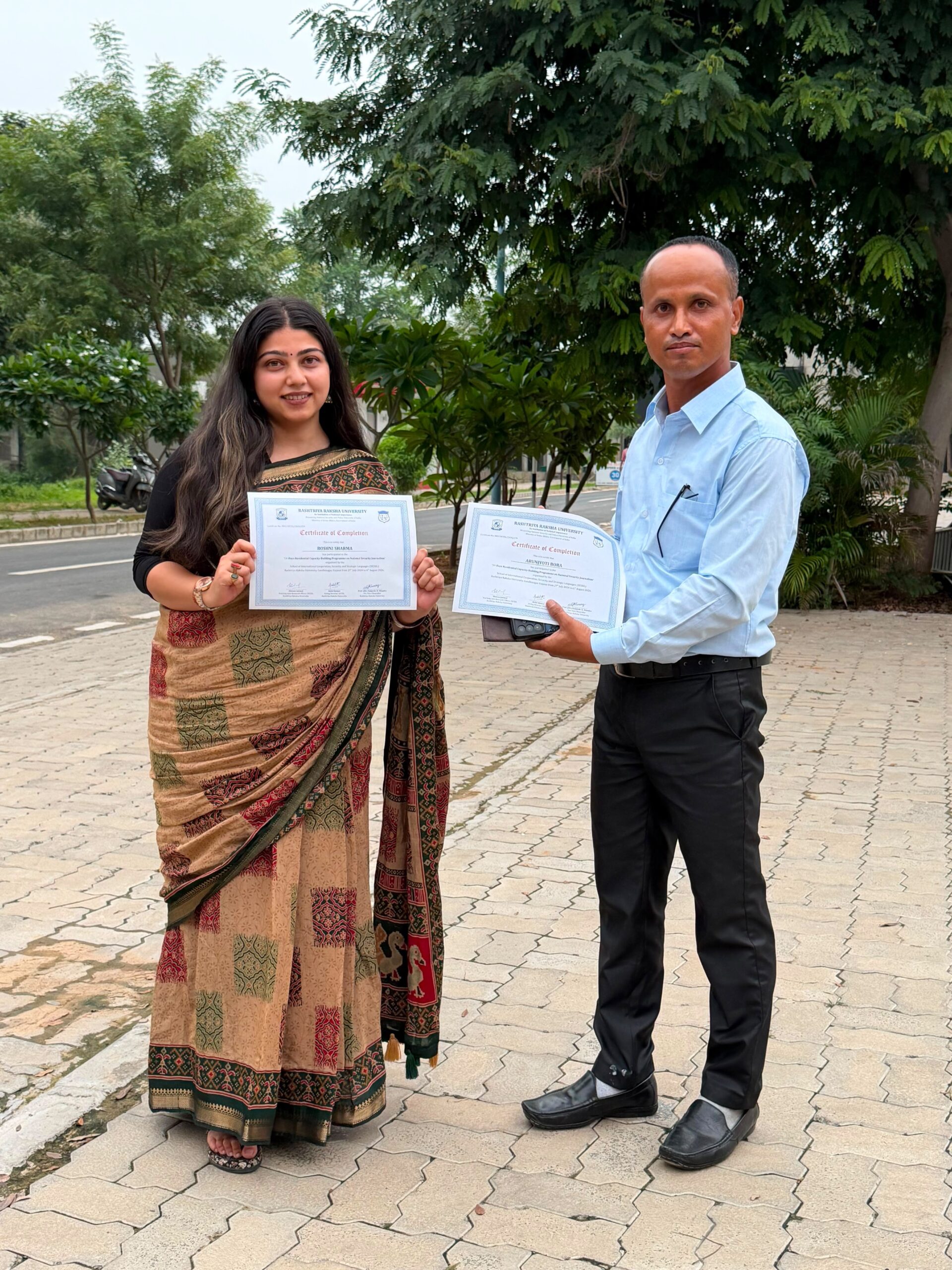
Two journalists from the Northeast were among 42 participants at the first residential National Security Journalism Workshop organised by Rashtriya Raksha University (RRU), Gujarat, under the aegis of the Ministry of Home Affairs (MHA).
The 11-day workshop, held from July 27 to August 6, brought together journalists, research scholars and academicians from across the country to strengthen their understanding of national security, strategic affairs and responsible reporting.
Representing the Northeast were Roshni Sharma from Sikkim and Arunjyoti Bohora from Assam.
Organised by RRU’s School of International Cooperation, Security and Strategic Languages (SICSSL), the programme focused on developing journalists’ capacity for accurate, fact-based and ethically responsible reporting on sensitive national security issues.
The workshop covered a wide range of subjects, including defence, internal security, terrorism, Left Wing Extremism, narcotics trafficking, cyber security, border management, and security challenges in the Northeast and Jammu and Kashmir.
As part of the programme, participants visited key national security institutions, including the Central Industrial Security Force (CISF) and the National Disaster Response Force (NDRF), where they gained first-hand exposure to security operations and institutional preparedness.
The participants also interacted with senior security practitioners, journalists, defence and law enforcement officials, cyber security experts and behavioural specialists.
An interactive session with the National Security Guard (NSG) featured demonstrations and discussions on counter-terrorism operations, along with the challenges involved in reporting responsibly on sensitive security matters.
Executive Editor of CNN-News18 Shawan Sen spoke on embedded journalism in conflict zones, emphasising the need to balance operational restrictions with editorial independence. Additional Director of the Narcotics Control Bureau Ketan Baliram Patil addressed issues surrounding reporting on drug trafficking and organised crime.
CRPF Inspector General (Operations) Gyanendra Kumar Verma discussed media reporting in conflict situations, particularly in the context of Left Wing Extremism.
Justice Aravind Kumar of the Supreme Court of India addressed the participants on the constitutional and judicial dimensions of national security, including the balance between individual rights and executive powers, as well as questions of accountability and legality.
At the valedictory function, the Vice Chancellor of RRU highlighted the growing importance of credible and responsible narratives on national security amid an increasingly competitive global information environment.
Referring to discussions following Operation Sindoor, he stressed the importance of ensuring that India’s perspective and ground realities are accurately represented in international media.
The workshop concluded with an emphasis on building a professionally equipped pool of journalists capable of covering national security issues with greater depth, analytical rigour and ethical responsibility, thereby contributing to a more informed public discourse on matters of national importance.