Sunday, May 10, 2026
Home Blog Page 54

Celebrating PM Modi’s G20 Presidency; A momentous milestone

0

PM’s vision of “Vasudhaiva Kutumbakam” has affectionately resonated across the globe & instilled a sense of national pride.

India is a land of diversity of faith, spirituality and traditions. This diversity has contributed to the richness of India’s history and culture, making it a truly unique and vibrant nation. As the ‘Mother of Democracy,’ its belief in democratic principles has been unwavering since time immemorial. The concept of Vasudhaiva Kutumbakam (“the world is one family”) is deeply embedded in the Indian soul, and it has guided India’s interactions with the world for centuries.

As India’s global influence grows, it remains committed to upholding the principles of Vasudhaiva Kutumbakam. This principle has guided India’s approach to international relations, emphasizing cooperation, peaceful coexistence, and mutual respect among nations. India believes that the world can only achieve peace and prosperity if we all work together as one family.

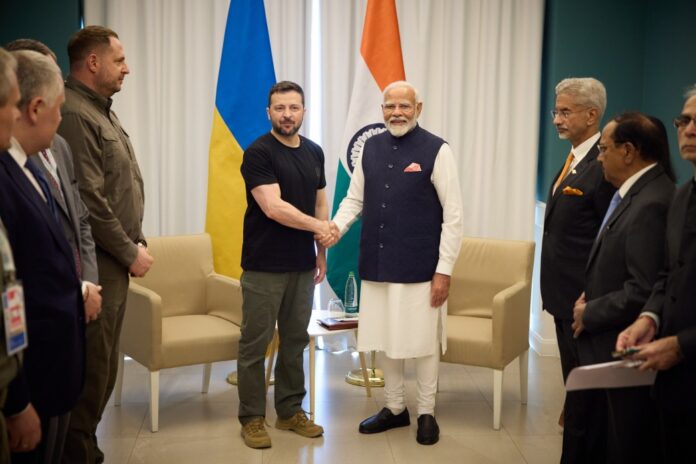
The 18th G20 Summit, which was held in India under the presidency of Hon’ble Prime Minister Narendra Modi, was a resounding success. The summit, which took place in New Delhi on September 9 and 10, 2023, brought together leaders from the world’s 20 largest economies (representing around 85% of global GDP) to discuss a wide range of global challenges, including the global economy, climate change, and sustainable development.

In pride and glory, I express my heartfelt congratulations to our honorable Prime Minister Shri Narendra Modi, for the triumphant culmination of India’s G20 Presidency. Under his visionary leadership, India has ascended to new heights of international diplomacy, leaving an indelible mark on the global stage.

Hon’ble Prime Minister Modi’s personal engagement with G20 leaders has been instrumental in building trust and  bonhomie ambience. His eloquent advocacy for the Global South and his emphasis on inclusive growth & sustainable development highlighting India’s empathy and solidarity with developing nations have resonated deeply wide across the international community. 

India’s G20 Presidency, under the leadership of Hon’ble Prime Minister Narendra Modi, can indeed be seen as a momentous diplomatic triumph for the country. Modi’s leadership of the G20 has been hailed as a voice of moderation, a beacon of hope in a world that is increasingly divided. Interestingly, Modi’s success as the G20 President has made him a role model for other developing countries. He has shown that developing countries can play a leading role in shaping the global agenda, synchronously balancing national interests with global commitments.

Hon’ble Prime Minister Modi’s deft stewardship has navigated India through complex global challenges, particularly in the aftermath of the COVID-19 pandemic. It may be recalled here that India played a crucial role in building global cooperation and symmetry to address the health, economic and social impacts of the pandemic. India has also demonstrated its diplomatic acumen and commitment to multilateralism and international cooperation, recognizing that global challenges can only be solved through collective action.

Hon’ble PM Modi’s G20 leadership has been praised by world leaders, experts, and the media alike. He has been credited with his ability to bring together diverse nations and achieve concrete outcomes. His efforts to ensure that the voices of emerging economies were heard and their interests were taken into account were widely appreciated. The summit’s discussions and policy outcomes reflected a balanced approach that aimed to bridge the gap between developed and developing nations, fostering global economic stability and sustainable development. Hon’ble PM Modi’s emphasis on creating an open and transparent platform for discussions allowed for meaningful exchanges of ideas and perspectives. This led to the formulation of innovative strategies and collaborative approaches to tackle various global issues, such as climate change, economic growth, sustainable development, and cybersecurity

It’s a matter of big pride that the world leaders hailed India’s hospitality and praised humble Prime Minister Modi for presiding over a successful summit, reflecting its noteworthy message of “Vasudhaiva Kutumbakam” which encapsulated the attention of all the delegates. Again, it was heartening to note the name “Bharat” being officially accorded, the G20- 2023 (branding, logo) reflected both Bharat and India. 

Meanwhile, the US State Department official spokesperson Matthew Miller,  said, “We absolutely believe it was a success”, simultaneously, he praised hon’ble PM Modi for his “decisive leadership” and for advocating the voice of the Global South.

The G20 Presidency has also boosted Modi’s popularity and further consolidated his position as a supreme leader. He has been praised for his leadership and his ability to bring together the world’s leaders. Now, he has emerged as a key figure in global governance.

Since the G20 presidency in India was spread in about 25 major cities across the country, the summit provided a valuable platform for India to showcase its vibrant culture and diverse heritage, fostering a deeper understanding of India’s values, aspirations and goodwill among participating countries. Besides, it created a big boom for the country’s pride, infrastructure development and economy. During the course of hosting the summit across the country, India invested in new and upgraded infrastructure such as conference facilities, transportation networks and accommodation. This investment in infrastructure development created jobs, stimulated economic growth and left a lasting legacy for the country.

Similarly, India’s G20 Presidency provided a platform for all the states to showcase its economic potential and project India as an attractive destination for global investors. The summit attracted foreign delegates and tourists, boosting the hospitality and tourism industries. The increased visibility and attention from the international media also drew foreign investment and business opportunities.

India’s G20 Presidency has been a resounding diplomatic triumph, marked by a series of significant milestones. The adoption of the New Delhi Declaration, the establishment of a global debt distress resolution framework, the advancement of sustainable development goals, embodied with a shared commitment to building a more resilient, peaceful, prosperous and equitable world are just a few notable examples. Furthermore, the Delhi Declaration on the Ukraine-Russia war was a strong statement of support for the prevailing miserable situation and a call for an end to the conflict. These outcomes bear testament to India’s ability to galvanize global action and drive positive change.

In another milestone development, India succeeds Africa entering in the G20, the membership of the African Union was long overdue & it all resolved under India’s presidency, indeed, a significant breakthrough in G20 history. With Modi’s huge global reputation & the legacy of India’s clout, it capitalized its poweress to get incredible things done, so this was absolutely an outstanding summit of its kind.

At the outset, India’s successful Chandrayaan moon mission was an added feature in the G 20 Summit. India’s successful Chandrayaan Moon mission is a testament to the country’s scientific prowess and its commitment to international cooperation. Most benevolently, the moon mission’s logistics concept is “likely” to be shared with fellow countries in the interest of humanity, and this is a shining example of India’s commitment to Vasudhaiva Kutumbakam, the principle of the world being one family. India is a valuable member of the global community, and its incredible achievements in space exploration are a source of pride for the world community.

In a significant development, Turkey President Recep Tayyip Erdogan’s support for India’s aspirations for a permanent seat in the UN Security Council is a gesture of great pride & glory. Erdogan said, “A country like India being there on the UN Security Council, “we would be proud”. But as you know, the world is bigger than…larger than five.” This expression shows that the summit was an opportunity for India to strengthen its ties with other countries & to showcase its potential in the global standing.

India’s G20 Presidency was a watershed moment in its global journey. The summit demonstrated India’s growing influence and its ability to shape the global agenda. Hon’ble Prime Minister Modi’s leadership has catapulted India into a leading role on the world stage. His vision of ‘One Earth, One Family, One Future’ has inspired millions across the globe. His leadership and acumen on issues such as climate change, sustainable development, and global health has earned huge respect and admiration of the international community. As India hands over the G20 Presidency to Brazil, it leaves behind a legacy of inclusiveness, cooperation, and progress. India has set a high standard for future G20 presidencies, and its contributions will continue to resonate in the years to come.

Once again, I extend my heartfelt congratulations to Hon’ble Prime Minister Modi and his team for their outstanding contribution to India’s G20 Presidency. This historic achievement is a source of immense pride for all Indians. We are grateful for their dedication, perseverance, and unwavering commitment to India’s global aspirations. Long live our beloved Prime Minister Shri Narendra Modi ji, long live his reign & noble governance with full of grace forever embracing India’s pride & glory. We feel blessed and fortunate under your leadership. Your vision and compassion resonate pure and virtuous, our nation is strong and proud under your visionary leadership. May your benevolence, wisdom and good deeds be forever enshrined, in the hearts and souls of all humanity.

Originally written by Manoj Joshi of Gangtok; Sikkim. He can be contacted at Mob; 8918422242.

Sikkim University, Vidya Bharati Sikkim, and Sikkim Vir Gorkha Ex-Servicemen Welfare Association came together to celebrate “Meri Mati Mera Desh”

0
"Sikkim Welfare Association "

Sikkim University, Vidya Bharati Sikkim, and Sikkim Vir Gorkha Ex-Servicemen Welfare Association came together to celebrate “Meri Mati Mera Desh” on August 31, 2023, at Chintan Bhawan in Gangtok, East Sikkim. 

The event was graced by the presence of Hon’ble Dr. Rajkumar Ranjan Singh Ji, Minister of State for Education and External Affairs, Government of India, as the Chief Guest. Brigadier Dhananjai Palsokar, Sena Medal, Deputy General Officer Commanding 17 Mountain Division, was the Guest of Honour. The keynote address was delivered by Dr. Sanjay Garg, OSD-AKAM, Ministry of Culture, Government of India, while the event was chaired by Prof. Avinash Khare, Hon’ble Vice Chancellor of Sikkim University. Other notable attendees included District Collector Tushar Nikhare, representatives from the Armed Forces, awardees, and students.

 The program began with the Khada Arpan and Deep Prajwalan ceremonies. Prof. Veenu Pant introduced the program and delivered a welcome address. The highlight of the event was the Meri Mati Mera Desh pledge, which was administered by the Hon’ble Minister. 

Dr. Sanjay Garg’s keynote address focused on the objective of Ajadi Ka Amrit Mohotsav, which aims to honor and recognize the unsung heroes of the Indian Freedom Struggle. He spoke about the various programs organized under the banner of Ajadi Ka Amrit Mohotsav and emphasized the importance of celebrating and honoring our unsung heroes. 

Brigadier Dhananjai Palsokar, Sena Medal, shared his experiences serving on the border and highlighted the crucial role played by the Indian Forces. He emphasized the need for unity among all Indians, urging everyone not to divide themselves based on caste or religion. 

Hon’ble Minister of State for Education and External Affairs, Dr. Rajkumar Ranjan Singh, spoke about India’s achievements in the past 75 years. He shed light on the idea behind Ajadi Ka Amrit Mohotsav, stating that it aims to recognize the contributions of all freedom fighters who may not have been adequately acknowledged. He encouraged all citizens to contribute towards the goal of 2047 and reiterated the importance of moving India forward. The Minister expressed gratitude to the brave soldiers and acknowledged the unwavering commitment of the Indian Armed Forces in safeguarding the nation. He also emphasized that as the journey of Amrit Mohotsav concludes, a new journey begins, known as Kartavya Kaal. He stressed the importance of remembering those who never returned from the borders and showing respect for their sacrifices and their families. He concluded his speech by thanking the Gorkha soldiers, Sikkim University, and Vidya Bharati Sikkim. 

Following the Minister’s speech, a program was held to honor decorated soldiers and the families of martyrs from the Indian Armed Forces. Mementos were also presented to the esteemed guests.

 The event concluded with a Presidential Address by Prof. Avinash Khare, Hon’ble Vice Chancellor of Sikkim University. Prof. Khare highlighted the university’s efforts in language preservation, the implementation of the National Education Policy, and emphasized the importance of preserving traditions and languages in the Kartavya Kaal.

 The event ended on a patriotic note, with all attendees joining in singing the national anthem.

CM PS Golay Collaborates with Brahma Kumaris Sikkim to Celebrate Raksha Bandhan and Promote Unity

0
" CM PS Golay Collaborates with Brahma Kumaris "

On the auspicious occasion of Raksha Bandhan, Chief Minister PS Golay hosted a event in collaboration with Brahma Kumaris Sikkim, aimed at unity, peace, and self-discovery among the staff and officials of the Chief Minister’s Office (CMO).

The event, which took place in Gangtok, witnessed the presence of Chief Minister Prem Singh Tamang, along with his wife, Krishna Rai, Minister of Power Department M.N. Sherpa, Minister of PHE Department Bhim Hang Subba, Former Minister G.M. Gurung, and followers of Brahma Kumari, among other dignitaries.

Brahma Kumaris, known for their emphasis on meditation and self-realization, played a significant role during the event. They highlighted the importance of Raksha Bandhan, a festival that transcends religious boundaries and signifies the bond of protection and care between individuals. The organization’s involvement in Raksha Bandhan celebrations extends to diverse locations, including prisons and schools, showcasing their all-encompassing approach.

One of the highlights of the event was the premiere of the music video “Hamra Pyara Sikkim” by Hillman Films. The video beautifully captured the essence of Sikkim and its people, adding a touch of cultural significance to the celebration.

In his speech, Chief Minister Prem Singh Tamang expressed gratitude to Brahma Kumaris for their dedication towards world peace and their presence at the event. He stressed the importance of a peaceful foundation for success, regardless of one’s occupation. He further emphasized that working at the CM’s office is synonymous with working for the people of Sikkim, calling for unity among individuals.

The Chief Minister acknowledged the various Brahma Kumari centers in Sikkim and praised their commitment to the welfare of the people. He reaffirmed his commitment to ensuring peace and well-being in the state, underscoring the significance of teamwork.

PS Tamang (Golay) noted the remarkable progress within the state, which now offers improved medical facilities, eliminating the need for underprivileged individuals to seek treatment outside Sikkim. Similarly, students have access to free coaching classes, reducing the necessity to seek educational support elsewhere.

The event concluded with the Brahma Kumaris tying the pure knot of Raksha Bandhan to the staff of the CMO, symbolizing the bond of protection and care. Chief Minister Prem Singh Tamang and his wife felicitated the representatives of Brahma Kumaris, highlighting their role in promoting positive values and unity within the community.

The event served as a reminder of the importance of unity, peace, and self-discovery in building a strong and harmonious society. Through collaboration and meaningful initiatives, Gangtok continues to set an example for fostering positive values and inclusivity.

Sikkim’s Chief Minister Launches Seema Darshan Initiative to Celebrate Raksha Bandhan

0
"Seema Darshan Initiative launch"

Sikkim’s Chief Minister PS Golay launched the Seema Darshan initiative today under the Vibrant Villages Programme. The initiative, aimed at celebrating Raksha Bandhan with a special focus on border areas, witnessed the participation of around 50 college and university students.

As part of the initiative, students embarked on a journey to the Indo-China Nathu La border, where they tied Rakhis to personnel from the Indian Army and Indo-Tibetan Border Police (ITBP). The act symbolized the trust and protection inherent in the Raksha Bandhan tradition.

Chief Minister Golay expressed his enthusiasm for the initiative, stating, “Sikkim recognizes the importance of unity, diversity, and national security. The Seema Darshan initiative not only bridges the gap between civilians and our brave armed forces but also highlights our commitment to developing vibrant communities in border areas.”

Highlighting Prime Minister Narendra Modi’s vision of uplifting the last village of border states, Chief Minister Golay extended his gratitude to the Prime Minister for prioritizing the development of such regions.

The Vibrant Villages Programme aligns with this vision and seeks to transform rural areas into thriving communities. Under this program, Tsomgo village has been identified for comprehensive development, making it a hub of growth and opportunity.

Speaking at the event, Secretary of the Planning & Development Department, Shri Rinzing Chewang Bhutia, outlined the significance of the initiative. He stated, “Seema Darshan not only reinforces the bond between civilians and our armed forces but also brings a renewed sense of unity and purpose to the region.”

The students’ gesture of tying Rakhis to the Chief Minister, armed forces personnel, and the local community members resonated deeply with the spirit of Raksha Bandhan. Chief Minister emphasized the importance of protecting the harmony and prosperity of the state, urging everyone to uphold the values that form the foundation of their society.

As the Seema Darshan initiative sets a heartening precedent for celebrating Raksha Bandhan, it also underscores the commitment of Sikkim towards national security and community development, echoing the sentiment that unity is the cornerstone of a strong and vibrant nation.

CM of Sikkim Honors ‘Yakthung Star: Season 1’ Winners in Rangpo 

0
"CM of Sikkim Honors 'Yakthung Star"

Sikkim hosted a grand reception to honor the winners of “Yakthung Star: Season 1.” The event, held on August 29, 2023, was a testament to the power of unity and the triumph of talent within the Limboo community and the larger Sikkimese society.

Anjana Iimboo, the winner of the singing competition, and Aita Hang Limboo, who secured the third position, were the stars of the event. The competition, held in the Birtamode, Nepal, showcased their exceptional abilities and marked a milestone for Sikkim’s cultural scene. The reception, graced by Chief Minister Prem Singh Tamang and his wife Krishna Rai, turned into a jubilant affair with ministers, MLAs, and other dignitaries also attended.

Chief Minister Golay’s admiration for the winners was palpable as he personally felicitated them. Anjana Limboo, in her heartfelt speech, lauded Chief Minister Golay’s unwavering support for the Limboo community, underlining initiatives such as the construction of community halls. She also shared her personal journey, resonating with aspiring artists.

Aita Hang Limboo, who referred to himself as a “chalak,” showcasing his journey as a driver, expressed his gratitude for the support he received and his pride in representing his community on a national stage.

Chief Minister Golay, in his speech, acknowledged the duo’s achievement not just as a Limboo triumph but as a moment of pride for all of Sikkim. His commitment to supporting future seasons of “Yakthung Star” and his plans to promote Limboo arts and culture further underscored his dedication.

As the event unfolded, it became evident that the celebration was not just about individual accomplishments but a reminder of Sikkim’s tradition of finding joy in others’ success. Chief Minister Golay’s encouragement for the winners to continue shining and his call to step out of the confines of their homes echoed the spirit of progress and growth.

The reception in Rangpo was more than a celebration; it was a reflection of the harmonious blend of talent, culture, and unity that defines Sikkim. The spotlight on Anjana Iimboo and Aita Hang Limboo illuminated the boundless potential of Sikkimese youth, setting the stage for an even brighter future.

Senior Advocate Basava Prabhu S Patil Appointed Advocate General of Sikkim

0
" Senior Advocate Basava Prabhu S Patil "

Senior Advocate Basava Prabhu S Patil Appointed Advocate General of Sikkim

Supreme Court’s accomplished lawyer, Senior Advocate Basava Prabhu S Patil, has been designated as the Advocate General of Sikkim. The official notification from the Law and Parliamentary Affairs Department of the Sikkim Government was released on Monday.

An alumnus of University Law College, Bengaluru, Patil joined the Karnataka State Bar Council as an advocate in 1991. Notably, he attained the position of Senior Advocate from the Karnataka High Court at just 39 years old in 2008. Currently practicing before the Supreme Court, he also represents cases in various High Courts, tribunals, and domestic as well as international arbitrations.

Patil has an extensive record of representing Karnataka and Andhra Pradesh States, India’s Law Minister, Chief Ministers, and major conglomerates such as Tata, Reliance, and GMR. Moreover, he serves on the Supreme Court Board of Examiners for the advocate-on-record exam.”

MLA Y.T. Lepcha Advocates BJP-SKM Alliance for 2024

0

Y.T. Lepcha, the senior BJP leader and MLA from Gangtok, has surprised everyone by suggesting that the BJP and the Sikkim Krantikari Morcha (SKM) should join hands for the upcoming 2024 elections in Sikkim. This idea comes at a time when top BJP leaders have denied any plans for an alliance with SKM. YT Lepcha believes that such an alliance is necessary because the BJP faced tough challenges in previous elections.

He believes that teaming up with SKM is crucial for the BJP’s chances in the Lok Sabha elections in 2024. He says that without this partnership, the BJP might struggle to even get 500 votes. He pointed to the past Panchayat Elections where the BJP’s candidates couldn’t get more than 50 votes. However, recent elections saw victories for BJP candidates in places like DPH Ward, Gangtok, and Rumtek, he thanks to SKM’s support.

Lepcha emphasized the importance of this alliance, stating that working together with national and regional parties is necessary to solve Sikkim’s challenges. He suggested that this partnership could help address the state’s issues and contribute to its development.

Even though top BJP leaders haven’t shown interest in an alliance with SKM, Lepcha’s viewpoint highlights the potential benefits of such cooperation. This idea of a BJP-SKM alliance has caught the attention of political observers and the public.

As Sikkim’s political scene evolves, the proposal for a BJP-SKM alliance adds an interesting twist to the upcoming elections. Whether this partnership becomes a reality or not remains to be seen, but it definitely sparks discussions about how political alliances can shape the state’s future. With Lepcha advocating for unity to address Sikkim’s challenges, the question is whether practical considerations will overcome ideological differences, leading to a new political dynamic in the region.”

ISRO Celebrates Successful Chandrayaan-3 Mission Under the Leadership of PM Shri Narendra Modi

0

India is a land of profound insights where ancient wisdom shines bright. This beautiful country is a treasure trove of knowledge and home to some of the earliest civilizations in the world. It has a rich history of scientific and technological innovation, dating back to thousands of years. India’s ancient scientific, Vedic, and cosmic civilization is a source of great inspiration and pride for Indians. Its contributions to science, medicine, philosophy, and spirituality have enriched our understanding of the universe and our place in it.

Wow! The Chandrayaan-3 soft landing on the south pole of the Moon is a historic achievement for India and a major milestone in space exploration. All Indians are feeling an immense pride & their spirits soaring higher in the depth of lunar expanse, indeed a dream come true for 140 crore Indians. When the triumph was achieved, the symphony of ISRO’s potential, innovation & teamwork resounded marvelously across the globe.

India made history by becoming the first country to soft land its spacecraft Chandrayaan-3 on the south pole of the Moon. Ths successful moon mission is a milestone feat in the field of space exploration and it is a testament to the ingenuity and dedication of the scientists and engineers at the Indian Space Research Organisation (ISRO). 

As per the sources, the Lunar South Pole also known as the “dark side,” is the most sought after captivating region due to its unique features & completely unexplored since existence, particularly, a  challenging place to land, as it is covered in craters and has a thin atmosphere. Despite this, the ISRO team overcame all  challenges and successfully landed the Chandrayaan-3 lander on the south pole surface of the Moon at 6.04 pm IST on 23 August 2023. India is the only country to do so. This mysterious hidden belt is thought to be rich in water ice, which could be a valuable resource for future space exploration. The Chandrayaan-3 is predicted to revolutionize our deep understanding of the Moon.

Now with this unbelievable breakthrough, India has entered into the Space Elite Club. Additionally, Chandrayaan-3 accomplishment will open up India’s space economy to a significant level. ISRO’s remarkable feat has opened up a new horizon of opportunities for several start-ups and companies involved in sectors such as space tech, aerospace, defense and R&D. ISRO’s success has potential to boost the space economy and ‘Make in India’ campaign.

In the realm of space exploration, the Indian Vedic texts do provide a fascinating glimpse into the ancient Indian understanding of the cosmos. 

The Vedas are revered as sacred scriptures and contain a vast array of knowledge across various subjects, including cosmology, space travel and the celestial realm.

The Rig Veda, the oldest of the Vedas, mentions the sun, moon, stars, and planets. It also describes the solar system and the universe. The Rig Veda mentions that the sun is the center of the solar system and that the planets revolve around it. It also describes the 27 nakshatras, (lunar mansions), which are used in Vedic astrology. The Upanishads, another ancient Vedic text, go even further in their discussion of space and cosmology. They talk about the different layers of the universe or parallel universe and the nature of time and space. It also reminds us that India has a long and rich history of scientific exploration and sophisticated understanding of space and planets thousands of years ago. 

There are many passages in the Vedas that could be interpreted as describing space travel. Through Astrophysics/space travel process, our ancient sages freely used to move from Earth to far-off planets like Brahma loka (about 26 thousands light years away from earth, possibly in the distant Galaxies), Pitriloka, Devaloka which had different time speeds than Earth as described in the Bhagavatapurana IX 3.29-36 and the Vishnupurana IV 1.20-39.

Interestingly, the Rig Veda is the first one to acknowledge the existence of the Solar System. While history credits Nicolaus Copernicus for proposing the heliocentric model of our solar system, it was the Rig Veda that first mentioned the central placement of the sun and other planets orbiting it in the solar system- Rig Veda 1.164.13.

Additionally, the secret mantra ‘Hanuman Chalisa’ precisely calculates the  distance between Earth and the Sun.

“Yug sahasra yojana par bhanu,

leelyo taahi madhura phal jaanu” 

According to Indian Rig Veda 10.22.14, it figured out gravity before the west did. Further, way before Isaac Newton explained gravity, ancient Indian scholars had already figured out how it worked. 

Likewise, the ancient Indian sages already knew about the speed of the Light & they also figured out the exact length of  a year. Indian sages were the first ones to measure the circumference of Earth & also the value of pi. More surprisingly, the ‘Mahabharata’ mentions the concept of cloning &  test tube babies etc.

Interestingly, the Vedas offer a unique perspective on the cosmos. In Vedic verses, secrets of the cosmos were found, they are full of symbolism and metaphor, and it is important to approach their descriptions with an open mind and a willingness to see beyond the literal meaning. The Vedic view of the cosmos is both scientific and spiritual. It is based on a deep understanding of the natural world, but it also goes beyond the physical realm to explore the metaphysical and spiritual dimensions of reality. The Indian wonders of ancient wisdom can coexist alongside the marvels of contemporary scientific progress. Both offer valuable insights into the nature of the universe, and both can help us to live more meaningful and fulfilling lives.

Big congratulations to the Indian Space Research Organisation (ISRO) and all the scientists and engineers who made this achievement possible. This is a proud moment for India and a shining example of our growing capabilities in space technology.

In this grand feat, we must bestow credit to our hon’ble Prime Minister Shri Narendra Modi for his vision and incessant support for the space program. He has made it a priority to make India a leader in space exploration, and this achievement is a testament to his commitment. His inspiring words, advocacy and encouragement for exploration have helped to keep the team motivated like a beacon of hope during the challenging times.

At the outset, heartily congratulating all the scientists & team Chandrayaan, ISRO, for achieving the momentous feat, hon’ble PM Modi expressed the Chandrayaan successful mission would “propel India’s journey beyond the Moon’s orbit”, the Sun and Venus were on ISRO’s agenda. Soon, ISRO will launch the ‘Aditya L-1’ mission for in-depth study of the Sun. Through the Gaganyaan mission, the country is diligently preparing for its first human spaceflight mission. India is repeatedly proving that the “sky is not the limit.” he said. Hon’ble PM Modi has announced that the point where Chandrayaan-3 landed on the Moon, will be called ‘Shivshakti’. He also announced that India will celebrate August 23 as ‘National Space Day’ to mark successful touchdown of Chandrayaan-3 mission’s lander.

Indeed, under PM Modi’s vibrant rule, India has evolved into a significant global player in defense, R&D, space science and technology. India’s space programme has grown steadily, achieving significant milestones. The successful Chandrayaan-3 lunar mission has put India in a leading position in the global space race and has made India a major player in the international space community. I am proud to be an Indian to see my country making such great strides in the field of space science and technology. Now, with pride in our hearts, every Indian stands tall and confident under the leadership of hon’ble PM Shri Narandra Modi, India will continue to achieve outstanding feats in the years to come & will continue to be a leader in science and technology. 

The successful Chandrayaan-3 mission is a major landmark in the history of Moon exploration. It is a reminder of the power of human ingenuity and the potential for discovery that lies beyond our own planet. The Chandrayaan-3 has already started its findings, now the whole world is excited to see what the Chandrayaan-3 mission will discover in the years to come,  hope it will certainly make a myriad of amazing discoveries that will amaze and inspire mankind.

(This Article is Originally Written By Manoj Joshi.
Of Gangtok; Sikkim can be contact at Mob; 8918422242)

Pakistan: A Failed Nation, Failed Its Minorities

0
" Pakistan: A Failed Nation"

Isn’t democracy already dead in Pakistan and the rule of the bigots surpassed the state? Why does Pakistan always have to prove that it’s no more a land of the pure but a land of radicals and extremists who are vehemently intolerant of other faiths and beliefs? 

Even the birth of Pakistan was based on religious intolerance and the establishment of a secular state is a pipe dream to date. The two-Nation theory propounded by the guardians of Pakistan at the core was flawed and assurances made by Jinnah to its minorities were hollow. Since then, there have been instances of discrimination, violence, and social marginalization against religious and ethnic minority groups in Pakistan. These issues can be attributed to a complex interplay of factors, including historical legacies, socio-economic disparities, political dynamics, and the influence of extremist ideologies

The recent attacks on Christians and their places of worship in Pakistan are yet another example of Pakistan sliding into the pit hole of Islamist radicalisation. Religious minorities had seen no prosperity since the inception of the bigot state. The segregation was aggravated when General Zia took over Pakistan in 1979 making the minorities on the verge of political and social extinction. Zia-ul-Haq put an end to debate, discussion and imposed arbitrary and coercive Islamization over the masses. He silenced secular voices and changed school curricula to pass on his bigoted worldview to the next generation. Alas! Pakistani leaders like Zia succeeded in spreading a radical version of Islam where no one except the believers of Islam has a right to live let alone practice or preach their religion.

Since then, its top-down Islamization of Pakistan continues to have an impact on every problem tearing Pakistan apart, including sectarian conflict, terrorism, and breaches of human rights. As a result of Pakistan’s increasing radicalization and racial supremacy, along with the religious minorities Hindus, Christians, and Sikhs ethnic and linguistic minorities like Ahmadiyya, Baloch, Kashmiris, and Shia are no longer able to breathe in Pakistan. It appears that Pakistan is on the verge of Collapse due to various kinds of socio-economic issues and conflicts and to counter its disintegration, such constructed acts of violence take place time and again.

Blasphemy is just an olive branch of the radical version of Islam that is used as a tool at the hands of radical forces to either humiliate, threaten or persecute religious minorities. Blasphemy laws in Pakistan, the persecution of minorities and their places of worship are indeed important and concerning issues that have attracted significant attention and criticism both within the country and internationally. It has been criticized for being overly strict, open to abuse, and disproportionately affecting religious minorities.

The Jaranwala incident in Pakistan which sparked on the pretext of blasphemy made Christian minorities more prone to violence and atrocities. After the reports of the alleged desecration of the Holy Quran spread across the masses, making the Muslim community outrageous about the incident resulting in the ensuing unrest. The incident witnessed attacks by the mob on the religious Christian minority, pillaging Christian homes, Churches and desecration of the Holy Bibles. A mere allegation or a rumour of Blasphemy in Pakistan can make mobs bloodthirsty and destructive to such a level that it undermines its ow legal institutions. At least 20 Churches and 86 houses of Christians were burnt down by the mob in Pakistan. One thing that made this episode very evident is that in Pakistan, vigilantes predominate above the state and minorities remain in the abyss. If Pakistani authorities had prioritized societal growth and education instead of encouraging radical and extremist thought processes in Pakistani youth, things may have turned out better. Vigilante Islamic extremists are infamous for entrapping religious minorities into blasphemy and Pakistani authorities and its judicial system have failed to contain such repeated attacks. Even after continued condemnation from around the world, the attacks on the Christian minorities are continued with impunity from the State. Late at night on 22 August 2023, a few days after the Jaranwala incident, Tehreek-e-Labbaik (TLP) extremists attacked Christians and burnt Churches in Madina town, Faisalabad, Pakistan.

No one else but the Pakistani state itself is one of the main forces behind the oppression and persecution of minorities, in addition to the existence of an anti-Christian mindset among Jihadists, radicals, Islamist groups, and fanatics. Pakistan is undoubtedly a case of a failed state because the failure of the Pakistani state to defend the rights of its minorities is not due to a lack of capacity, but because of a lack of political will. In fact, one must categorize Pakistan’s persecution of Christians as an instance of state-sponsored terrorism. From the capital to the provinces, in both urban and rural regions, there is systematic discrimination against Christians, Hindus, and Sikhs throughout Pakistan.

Though violent attacks on Christians and other minorities by radical Islamists are quite regular in Pakistan, they frequently go unreported and the offenders escape punishment. Remember it’s not the rule of law but the rule of the murderous mob that prevails over Pakistan. Even if the security agencies are not personally biased against Christians, they are frequently too intimidated by the Islamic extremists and too afraid to assist the victims and instead quietly sit behind while watching the attacks as a mute spectator 

Religious extremists have also previously burned down and vandalized churches and prosecuted minorities on charges of blasphemy. 

Some of the recent violent attacks and hate crimes on the minorities of Pakistan are:

• One of the most prominent cases was that of Asia Bibi, a Christian woman who was accused of blasphemy in 2009 after a dispute with Muslim coworkers. She was convicted and sentenced to death. Her case gained international attention, leading to calls for her release. After years of legal battles, her conviction was overturned by the Pakistani Supreme Court in 2018. However, she faced threats and had to leave Pakistan to seek asylum in a Western country.

• Rimsha Masih, a young Christian girl, was accused of blasphemy in 2012 for allegedly burning pages containing Quranic verses. The case generated outrage and concern about the treatment of minors in such cases. Ultimately, the charges against her were dropped due to lack of evidence.

• In 2011, Salman Taseer, the Governor of Punjab, was assassinated by his own bodyguard for advocating for AsiaBibi. His son, Shaan Taseer, continued his father’s advocacy and faced threats and harassment who was later forced into exile due to safety concerns. 

• Around 3000 radicals stormed into Churches, damaged them, and attacked the local Christians in Sangla Hill in November 2005.

• Stephen Masih, a Pakistani Christian from Sialkot District, was detained for over two years for allegedly committing blasphemy. Pakistan also sentenced a young Christian man Shahzad Masih to execution by hanging over a false allegation of blasphemy. On November 22, 2022, a court reportedly sentenced Masih to death. 

• A teacher was assassinated earlier this month in Turbat, Baluchistan’s southernmost province, after being accused of blasphemy during a class.

• In Nankana’s rural area in February of this year, a defendant was dragged and kidnapped from a police station by the mob and executed for allegedly defiling Quranic pages.

The prevalence of hate crimes committed against religious minorities demonstrates how these people’s freedoms and rights are being trampled upon merely because they hold a different set of beliefs. Outside intervention is absolutely necessary to protect the religious minority communities from such atrocities that pose a threat to basic human rights and freedom because the Pakistani authorities have demonstrated to the world that they are unable to protect the rights, dignity, and freedom of their citizens.

Sikkim-Owned PSUs Facing Alarming Crisis: CAP Raises Concerns

0
"CAP Raises Concerns"

The recent press conference held at the Citizen Action Party’s (CAP) headquarters in Sikkim shed light on a deeply concerning issue: the precarious financial state of the state-owned Public Sector Undertakings (PSUs). Ganesh Rai, the leader of CAP, took the stage to reveal the distressing findings from the Comptroller and Auditor General (C&AG) of India’s audit of these entities, raising serious questions about their sustainability and impact on the state’s economy.

Ganesh Rai’s address to the media highlighted that the audit report, presented during a session at the Sikkim State Legislative Assembly, painted a disheartening picture of the PSUs’ financial health. These entities, established with the intent of driving economic growth and generating employment opportunities, have instead become a significant drain on the state’s resources. The accumulated losses of these PSUs for the fiscal year 2019-20 amounted to an astonishing Rs 2266.62 Crores.

Ganesh Rai emphasized the critical role that PSUs play in a state’s economic landscape. He pointed out that they are meant to contribute to revenue generation and employment opportunities, which in turn support the government’s developmental activities. However, the recent audit findings have highlighted a starkly different reality. Notably, a few PSUs managed to achieve negligible profits, while others suffered severe losses. This disparity in performance raises concerns about the effectiveness of the management and operations of these entities.

The audit report drew attention to several specific PSUs that are on the verge of closure due to their accumulated losses. Among these entities are Teesta Urja Limited (now renamed as Sikkim Urja Limited), Sikkim Power Investment Corporation Limited (SPICL), Sikkim Power Development Corporation Limited (SPDC), and SIDICO. The accumulated losses for these PSUs have eroded their capital to such an extent that they face an uncertain future. The audited figures show that the total outstanding loan till 2019-20 reached Rs 13468.47 Crores, the net loss for the same period was Rs 438.76 Crores, and the total capital employed was Rs 15054.90 Crores.

The state’s goal to promote developmental activities hinges on having a robust financial base, and the performance of PSUs has a significant impact on that objective. CAP’s press conference highlighted the urgency for the government to undertake measures to improve the financial health of these PSUs. This could involve restructuring, effective management strategies, and exploring opportunities for profit generation to mitigate the current losses.

The Sikkim government’s decision to levy a fine of Rs 5,000 for feeding monkeys has been seen as an effort to address the increasing instances of human-monkey conflict. However, this move also underscores the need for thoughtful conservation and wildlife management practices, especially considering the delicate balance between humans and animals in the region.

The CAP’s press conference raised a larger concern about the financial sustainability of state-owned enterprises and their ability to contribute positively to the state’s growth trajectory. As the government assesses its approach to PSUs, a comprehensive strategy to rejuvenate their financial health and operational efficiency could prove crucial to steering these entities away from further losses and potential closures.